
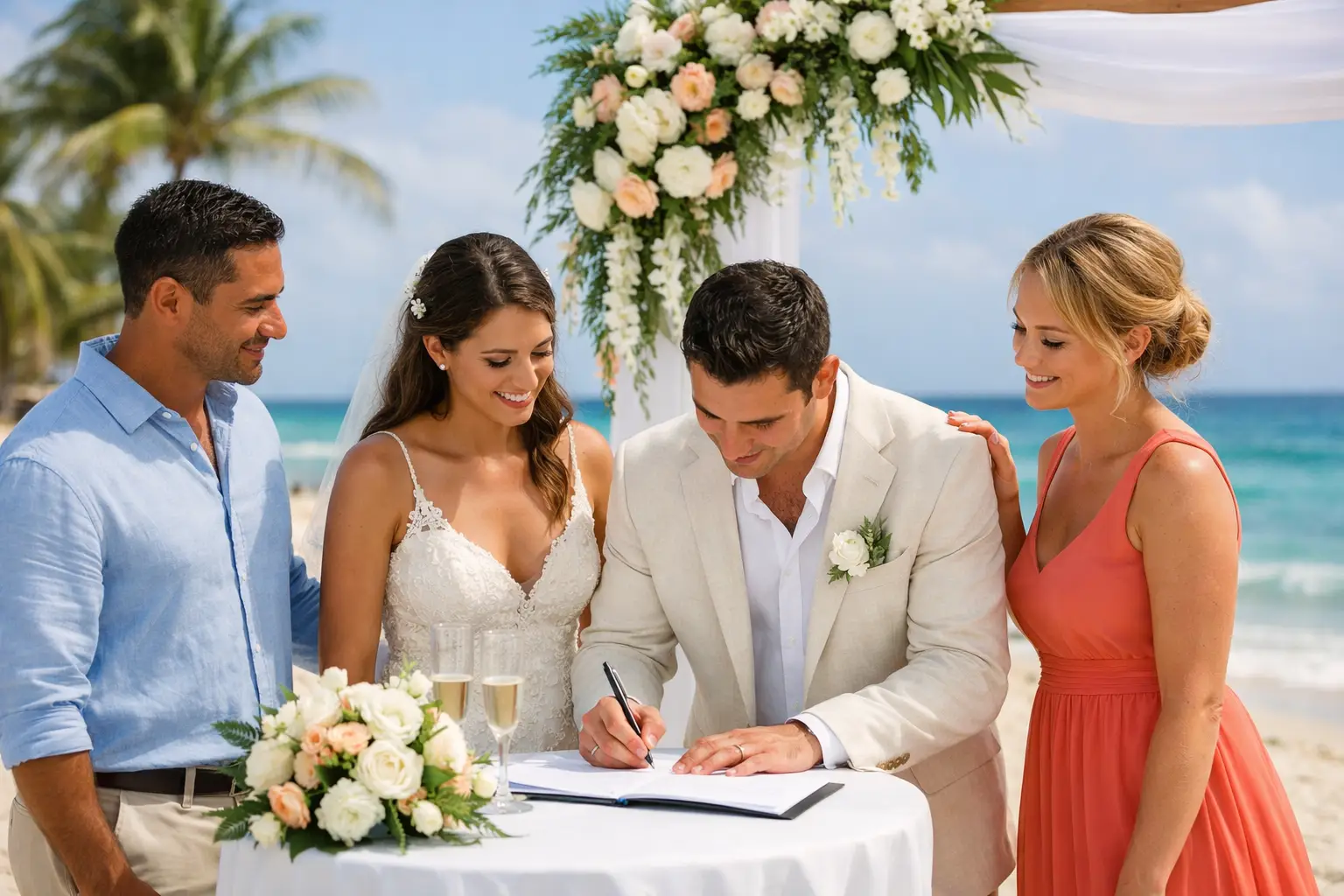
Do Mexico Weddings Need Witnesses? What Couples Need
The ocean is calm, your ceremony gazebo is dressed in soft florals, and the people you love are gathered on a Riviera Maya beach. Then a practical question appears: do Mexico weddings need witnesses? The answer depends entirely on whether you are having a legally binding civil marriage in Mexico or a symbolic ceremony designed around your celebration.
For most couples planning from the United States, a symbolic ceremony in Mexico paired with a legal marriage at home is the simplest path. But if exchanging legal vows in Mexico is part of your vision, witnesses are a real and necessary part of the planning conversation. Here is what to expect and how to make the decision that feels right for your love story.
Do Mexico Weddings Need Witnesses for a Legal Ceremony?
Yes. A legal civil wedding in Mexico generally requires witnesses to sign the marriage record. In the Mexican Caribbean, requirements are administered locally, so the exact number, identification rules, and paperwork can vary based on the municipality where your ceremony takes place.
Many civil ceremonies require four adult witnesses, often two for each partner. They must usually be present at the civil ceremony and provide valid government-issued photo identification. Depending on local requirements and the documents they present, copies of passports or other information may be requested in advance.
This is different from choosing a maid of honor and best man for a traditional role in your ceremony. Legal witnesses have an official purpose: they attest that the civil marriage took place. They may also be your closest friends or family members, but the legal role is what matters to the civil registrar.
Because requirements can change and local offices interpret procedures individually, it is wise to confirm the current rules for your exact venue area well before guests book their travel. A wedding in Cancun may follow a different administrative process than one in Tulum, Playa del Carmen, or Puerto Aventuras.
Symbolic Mexico Weddings: Witnesses Are Optional
A symbolic ceremony is not a legal marriage, which gives you much more freedom. You do not need official witnesses, a judge, or civil registry paperwork to exchange vows on the beach. You can invite loved ones to stand beside you, ask your children to participate, include parents in a handfasting ritual, or keep the ceremony entirely focused on the two of you.
For many US couples, this option offers the best balance of romance and practicality. You can complete the legal paperwork in your home state before or after your trip, then create the Mexico ceremony you have truly imagined without building your wedding day around government appointments and document requirements.
A symbolic ceremony can still feel deeply meaningful. Your officiant can personalize the script, speak about your journey together, incorporate readings, honor absent loved ones, and make space for private vows. The fact that it is symbolic does not make it less real emotionally. It simply separates the legal process from the celebration.
It also gives you flexibility if a key guest cannot attend. You will not be dependent on specific people arriving on time with acceptable IDs, which can be reassuring when flights, passports, and destination travel are involved.
What Legal Wedding Witnesses Need to Bring
If you choose a civil wedding in Mexico, select witnesses early and explain the responsibility clearly. They should be reliable adults who will arrive in the destination before the ceremony and be comfortable providing the identification required by the civil registry.
A current passport is commonly the most practical form of identification for international guests. The registrar or your planning team may also need photocopies in advance, along with basic details such as full legal names, dates of birth, nationality, occupation, and home address. Do not assume that a nickname, recently expired passport, or a name that differs from the wedding documents will be accepted.
The civil registry may require witnesses to be adults, and some locations may have rules about whether they must be related to the couple. Language can also be a consideration. If the ceremony is conducted in Spanish and you do not speak Spanish, a translator may be required. The same may apply to witnesses or guests who need to understand the legal proceeding.
There is a small but meaningful trade-off here. Asking your parents or closest friends to serve as witnesses can make them feel especially included. On the other hand, it places a legal responsibility on them during a trip that is meant to be relaxing. Couples with large wedding parties often find the choice easy. Couples eloping with only a few guests may prefer to keep the Mexico event symbolic.
The Legal Requirements Go Beyond Witnesses
Witnesses are only one piece of a legal Mexican wedding. The civil process may involve passports, birth certificates, tourist cards or immigration documentation, medical certificates or blood tests, application forms, and official translations or apostilles for certain documents. Some municipalities also require a waiting period or have limited appointment availability.
Your marriage certificate may be issued in Spanish, and you may need an apostille and translation for it to be recognized for certain purposes in the United States. The precise process depends on where you marry and where you live afterward.
This is why a legal wedding in Mexico can be beautiful but requires more lead time and careful coordination. It is not necessarily difficult when managed properly, but it is less flexible than a symbolic ceremony. A local planner can help you understand the venue-specific timeline, coordinate with the appropriate civil office, and ensure no detail is overlooked before your wedding week begins.
How to Choose the Right Ceremony Type
Start by asking what matters most to you. If you want the legal act of marriage to happen on the same beach where you exchange your vows, a civil ceremony may be worth the additional preparation. The signing, the official words, and the presence of witnesses can become a cherished part of the day.
If you care most about an effortless guest experience and a ceremony that feels completely personal, legalizing your marriage at home and holding a symbolic ceremony in Mexico may be the better fit. You can still have the aisle, music, officiant, exchange of rings, floral design, and joyful celebration under the stars. Nothing about the visual or emotional experience needs to be smaller.
There is also a middle ground. Some couples complete a brief civil ceremony at home with only the required parties, then treat their Mexico ceremony as their true wedding day. Others hold a civil ceremony in Mexico privately before the main event and reserve the beach celebration for a more relaxed symbolic exchange. The right choice is the one that protects both the meaning of the moment and the ease of your experience.
A Simple Planning Timeline for Witnesses
Once you know you want a legal marriage in Mexico, identify your witnesses before sending travel guidance to guests. Confirm that they have valid passports and can arrive with enough time for any required appointments. Give them a written reminder of the documents they need, rather than relying on a quick conversation months before departure.
Your planner should then verify the witness count and documentation with the relevant civil registry for your date and location. This confirmation is especially valuable for weddings in the Riviera Maya, where locations can be close together geographically but fall under different local administrative procedures.
At Weddings on the Beach, we believe logistics should support the romance, not distract from it. Whether your ceremony is legal or symbolic, thoughtful coordination leaves you free to be present for the warm sand, the music, the vows, and the people who crossed borders to celebrate with you.
If your heart is set on saying “I do” in Mexico, begin with the ceremony format, then build the paperwork and witness plan around it. With the right guidance, even the practical details can feel like a calm, well-cared-for part of your wedding story.
Comments are closed.